
Built to spec
Built to your engineered drawings, survey, and the real site conditions, not a one-size-fits-all approach forced to fit.
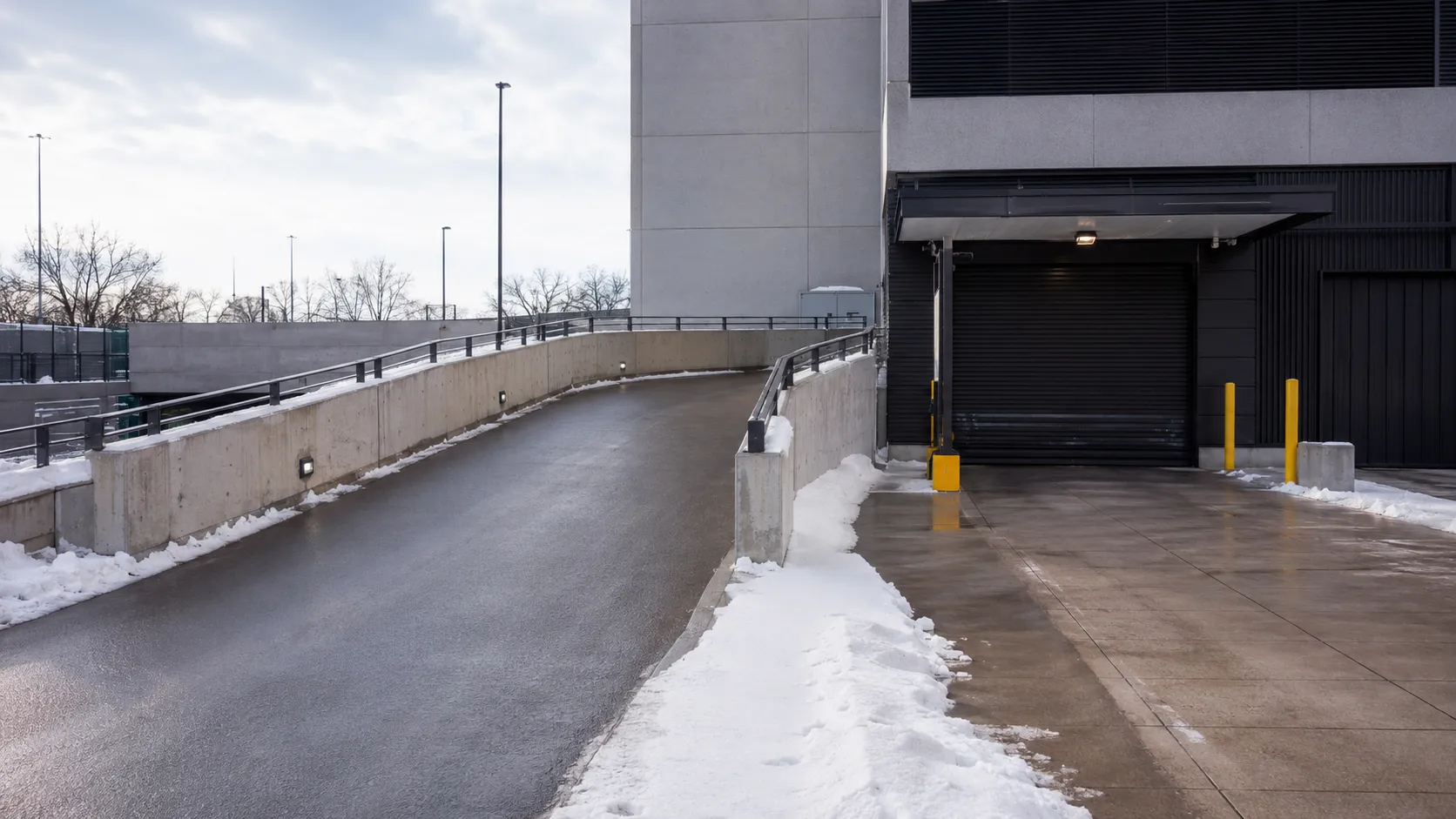
Harrowgate Group clears and treats commercial property across the GTA and Ontario on a written service plan, with our own trucks, loaders, and sidewalk crews, dispatched on a contracted trigger depth and logged on every visit.
Tell us what you need and we’ll get you a quote. Licensed, insured & WSIB-covered · Free, no-obligation quote & on-site assessment.
Licensed, insured & WSIB-covered · Free, no-obligation quote & on-site assessment.
Built to your engineered drawings, survey, and the real site conditions, not a one-size-fits-all approach forced to fit.
Durable materials and methods chosen for the load, traffic, and environment on site.
Send specs, drawings, or photos and get a free, no-obligation site visit and estimate with no guesswork.
Installation and site work completed in accordance with Ontario requirements.
Commercial snow removal is the contracted clearing and de-icing of a property through the winter, covering the parking areas, drive aisles, fire routes, loading areas, sidewalks, and entrances. Harrowgate Group performs the work across the GTA and Ontario on a written service level that fixes the trigger depth, the response window, the clearing order, and the de-icing standard before the season starts.
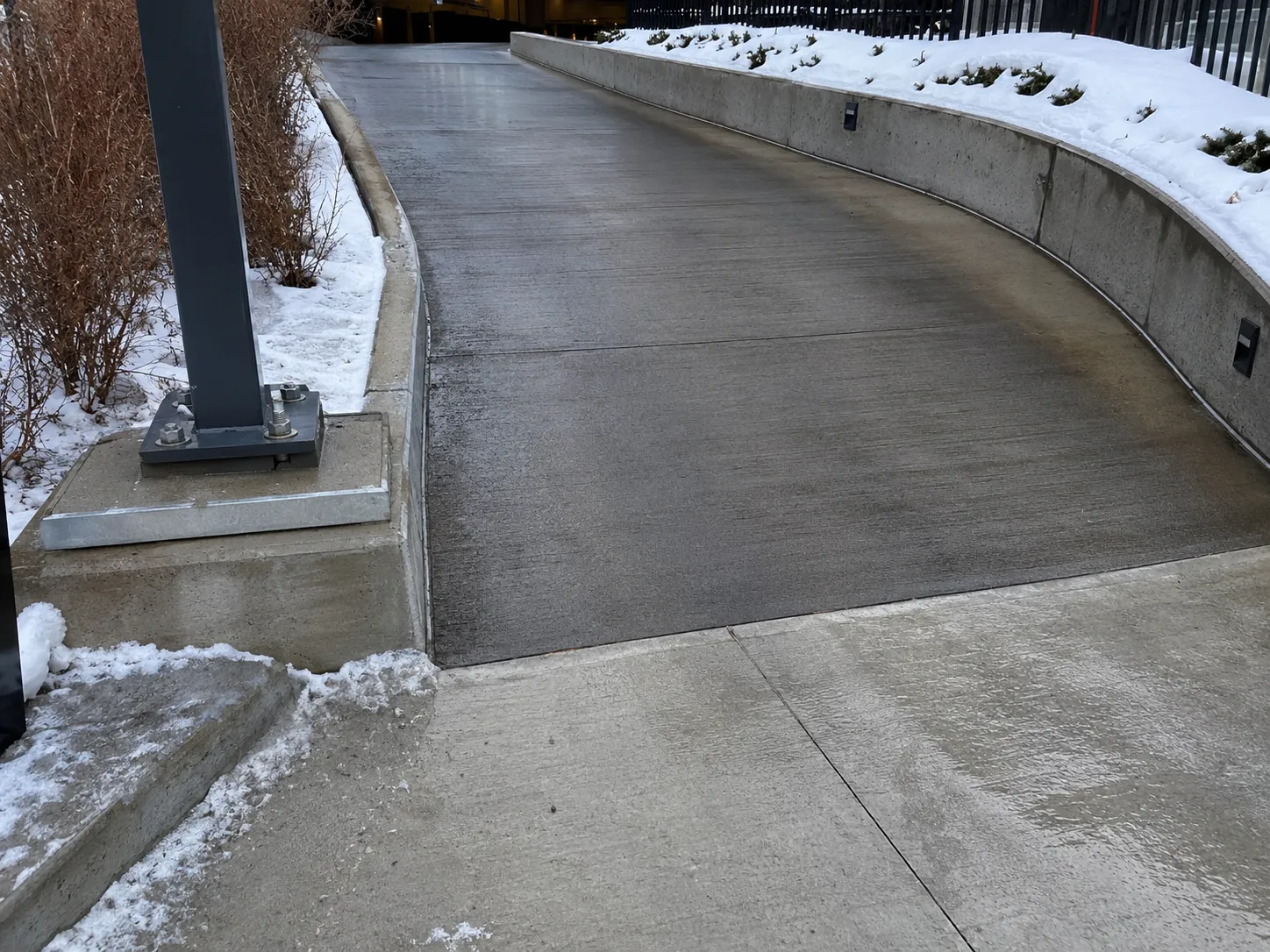
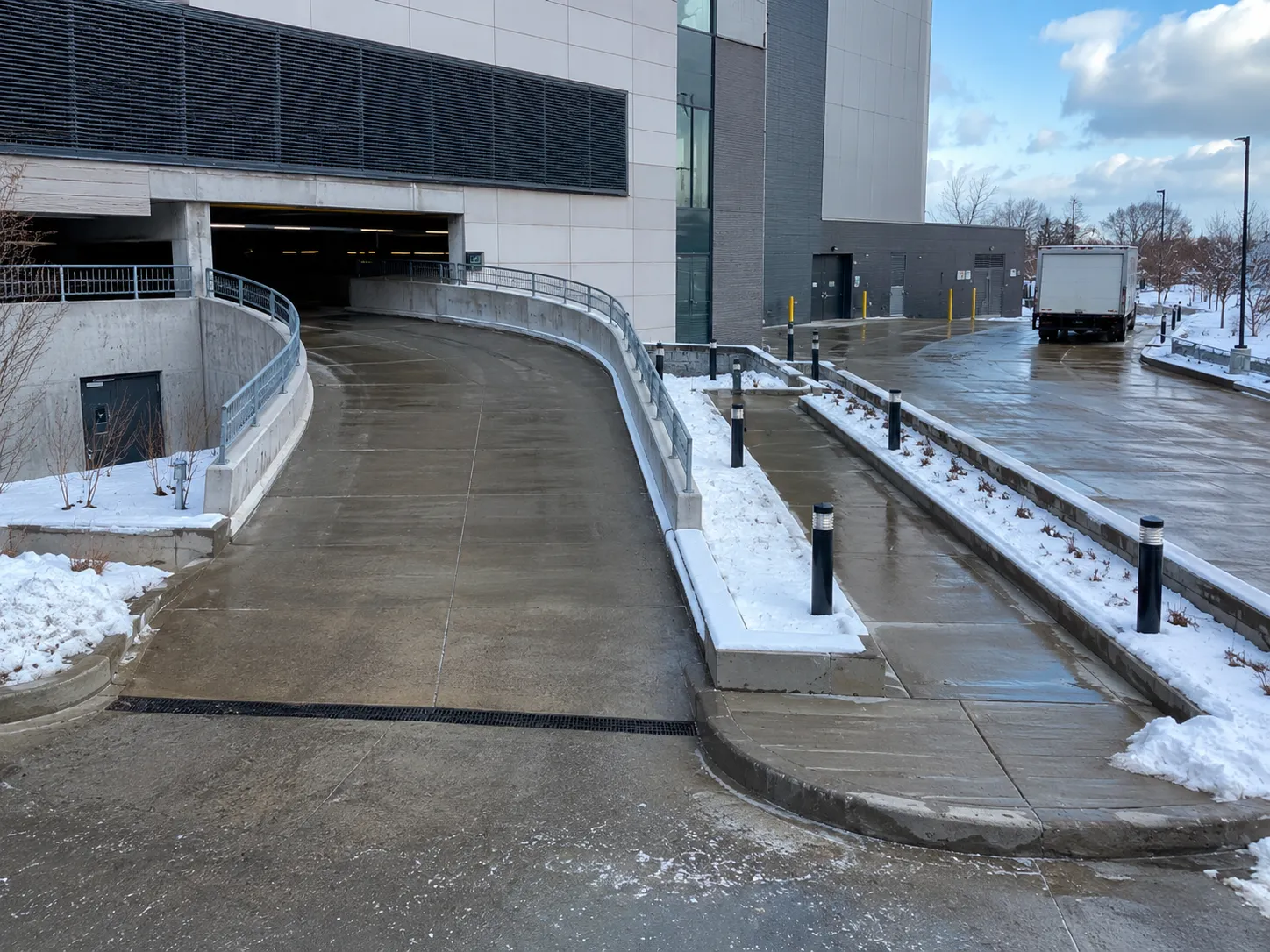
Every account starts with a pre-season site walk in the fall and ends with a documented spring cleanup. In between, the site sits on an assigned route with named crews, staged material, and a fixed sequence run the same way on every event.
The pre-season walk is where most of the value is created. We stake curbs, islands, catch basins, hydrants, bollards, and soft edges so nothing gets clipped once they are buried. We map the plow pattern, the direction snow moves, and where it gets stacked, keeping piles off catch basins, fire routes, sightlines at the exits, and accessible parking.
We measure the sidewalk runs and the entrances, confirm which surfaces are zero tolerance, and note anything that has caused an ice problem before, a downspout discharging across a walkway, a low spot that ponds and refreezes, a ramp that drains the wrong way.
During an event the sequence is fixed. We watch the forecast and pre-treat with brine or treated salt ahead of a storm where the timing and the surface allow it, which stops the snow bonding to the pavement and makes the first pass far more effective. We dispatch at the contracted trigger depth rather than waiting for the storm to finish.
Plow trucks and loaders with box pushers clear the lot to the mapped pattern; skid steers handle the tight areas, the islands, and the curb lines; sidewalk machines and hand crews clear the walks, the entrances, the stairs, and the accessible routes alongside the lot rather than after it. On a long event we come back and keep coming back, because a single pass at the end leaves a packed base that no amount of salt will fix.
De-icing happens after clearing, not instead of it. Salt applied on top of packed snow does very little; salt applied to a cleared surface breaks the bond and holds it through the freeze cycle. Rates are set to the surface temperature and the forecast, not thrown down by habit. Every visit is logged with the dispatch trigger, the time on and off site, the areas cleared, the material applied and where, and the conditions found on arrival.
Trigger depths on commercial sites are commonly set at 2.5 cm or 5 cm, with sidewalks and entrances often triggered lower than the parking areas. Material selection follows temperature: sodium chloride is effective to roughly minus 10 degrees Celsius, below which magnesium or calcium chloride blends do the work.
Brine, a salt solution applied before an event, is the anti-icing tool. It prevents the bond forming rather than breaking one that already has, uses less chloride than reactive salting, and does not bounce or scatter off the surface the way dry rock salt does. Pre-wetting dry salt at the spreader achieves a similar effect: the material activates faster and stays where it lands instead of ending up in the landscaping.
Chloride use is governed in Canada by the Code of Practice for the Environmental Management of Road Salts, which applies to organizations using more than 500 tonnes a year on a five year rolling average, and to any organization operating in a salt vulnerable area. Calibrated spreaders, application rates matched to pavement temperature, and covered material storage are the practices that keep chloride out of the storm system and off the landscaping.
Two Ontario obligations shape how a commercial site has to be serviced. Under the Accessibility for Ontarians with Disabilities Act, accessible parking spaces and the barrier-free path from them to the entrance have to be maintained, which means an accessible stall is not available as snow storage.
Municipal clearing bylaws set the deadline for the public sidewalk fronting a property; in Toronto the requirement is to clear it within 12 hours of the snowfall ending, and to apply sand or salt if the surface stays slippery, with fines attached. Both are written into the service plan rather than left to interpretation.
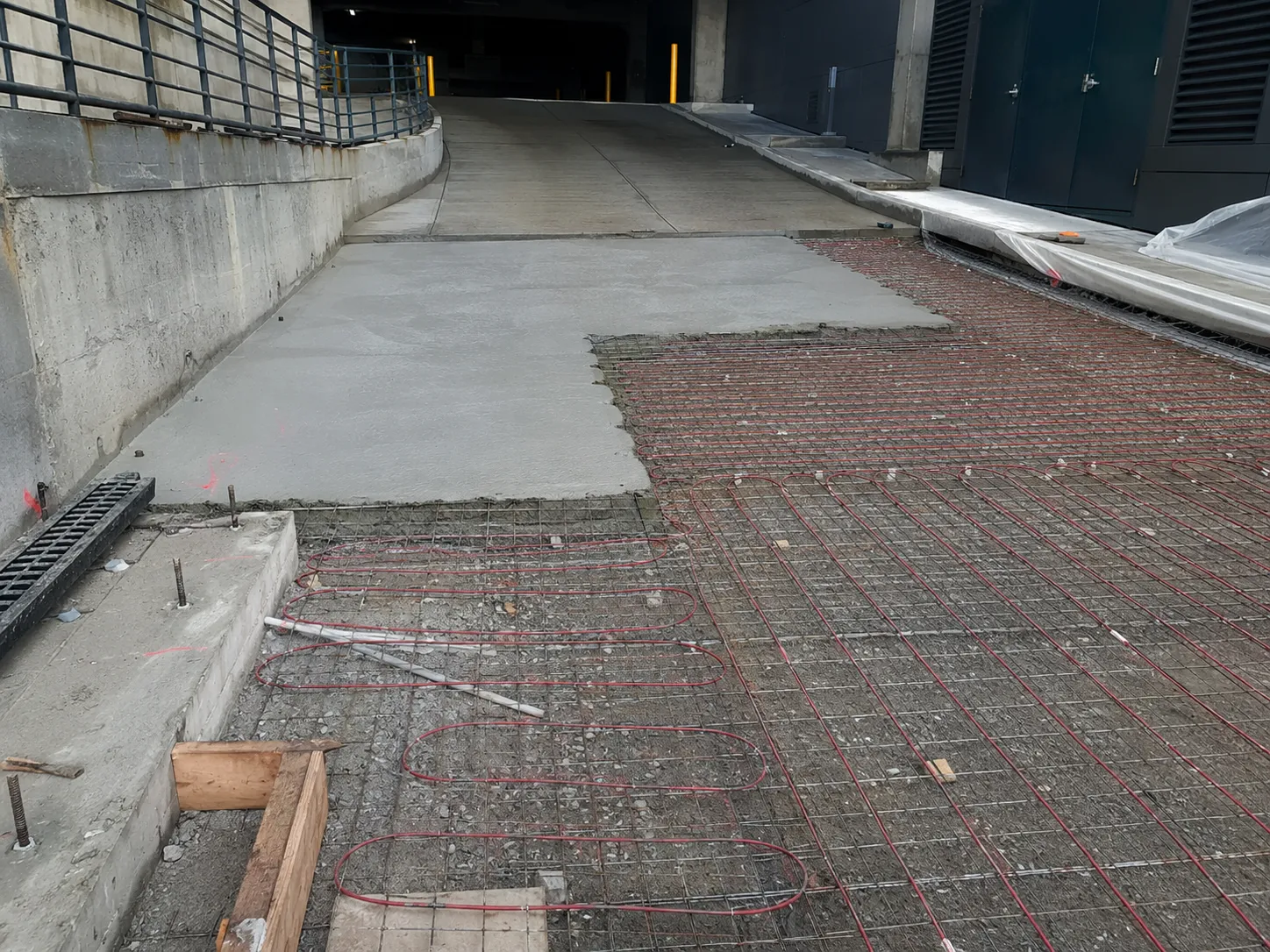
Salt also attacks the things it lands on. Chloride drives corrosion in reinforcing steel and causes surface scaling on concrete that has not fully cured, so new pours, ramps, and garage decks get treated with more care and, where appropriate, alternative products. That is the same durability problem our concrete crews spend the rest of the year solving.
Have drawings for snow removal? Send them over and we will scope it.
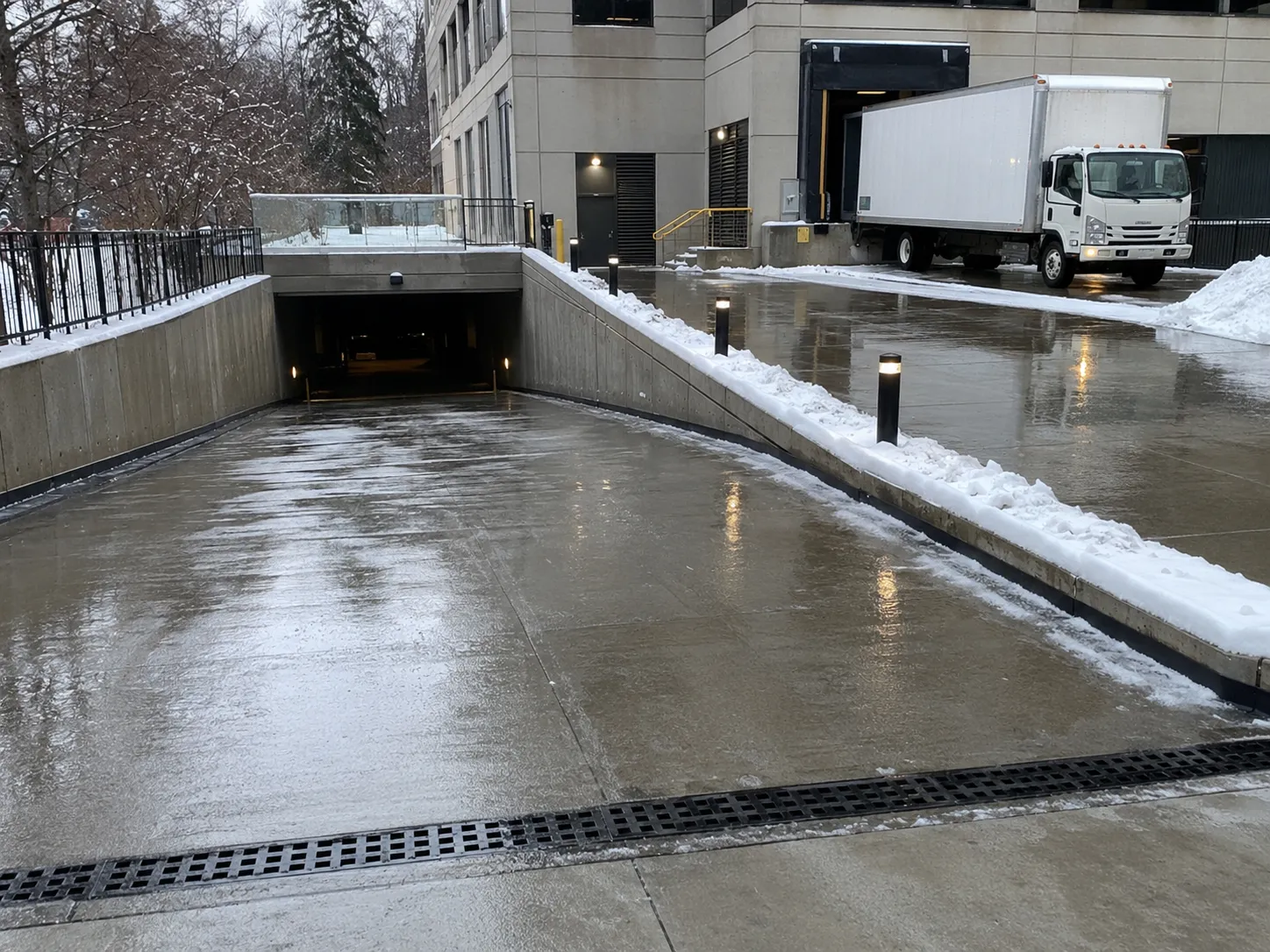
Clean site work and a tidy finish, coordinated with your engineers, the other trades, and the surrounding site conditions, built to the engineered drawings and the applicable codes.
Plowing is the mechanical clearing of snow from a surface. Snow removal is the full winter service: plowing, sidewalk and entrance clearing, de-icing, snow stacking, hauling when the site runs out of room, and the service record for each visit. Most commercial contracts need the whole service, not just the plow.
Commercial sites commonly dispatch at 2.5 cm or 5 cm of accumulation, with sidewalks and entrances often triggered lower than the parking areas. The right number depends on when the property has to open and how much pedestrian traffic it carries. Harrowgate Group sets it in writing before the season so there is no dispute mid-storm.
Section 6.1 of Ontario's Occupiers' Liability Act requires written notice within 60 days of a snow or ice injury, served on the occupier or on the contractor hired to clear the site. The contractor is a named party in that chain. A complete, time-stamped service record is the practical defence, which is why Harrowgate Group logs every visit.
Two reasons. It was applied over packed snow instead of a cleared surface, so it never reached the pavement. Or the surface was too cold: sodium chloride loses practical effectiveness around minus 10 degrees Celsius, and below that a magnesium or calcium chloride blend is needed. Harrowgate Group clears first and matches material to pavement temperature.
Late summer and early fall. Routes are built around the equipment and crews assigned to them, and a route fills. Booking in August or September also leaves time for the pre-season site walk, staking, and route mapping that make the first storm go properly rather than being figured out during it.
No. Under the Accessibility for Ontarians with Disabilities Act, accessible parking and the barrier-free path from it to the entrance have to remain available, so using an accessible stall for snow storage is a compliance failure. Harrowgate Group maps storage locations before the season specifically to avoid it.
When the piles start costing the property parking it needs, blocking sightlines at an exit, burying catch basins so meltwater runs across the drive aisle and refreezes, or encroaching on fire routes and accessible stalls. On tight urban sites, hauling is planned into the season rather than called in as an emergency.
A site plan or an aerial and the address is enough to start. Lot area, sidewalk lengths, the number of entrances, the hours the property has to be open, and any history of ice complaints let us price it accurately. Send drawings or a description through the quote form and we will walk the site.
Still have a question about snow removal? Ask our team directly.
Commercial and heavy-civil construction delivered for developers, contractors, property managers, and municipalities.
Send drawings, a site plan, or a description of the scope. Harrowgate Group is licensed, insured, and WSIB-covered.
Licensed, Insured & WSIB-Covered, work managed and documented on every job
Tell us what you need and we’ll get you a quote. Licensed, insured & WSIB-covered · Free, no-obligation quote & on-site assessment.
Companies We've Worked With
Harrowgate Group delivers commercial and heavy-civil construction for developers, contractors, institutions, municipalities, and property groups across Ontario.
 Popeyes
  Tim Hortons
  Subway
  University of Toronto
  Madison Group
  RioCan
  Women's College Hospital
  Starbucks
  Mazda
Mazda  TD Bank
  City of Toronto Popeyes Tim Hortons Subway University of Toronto Madison Group RioCan Women's College Hospital Starbucks Mazda TD Bank City of Toronto
 Three fields. We reply with the next step.
Thanks, we will call you shortly.
Press Esc to close
Marcus
Project Coordinator