
Built to spec
Built to your engineered drawings, survey, and the real site conditions, not a one-size-fits-all approach forced to fit.
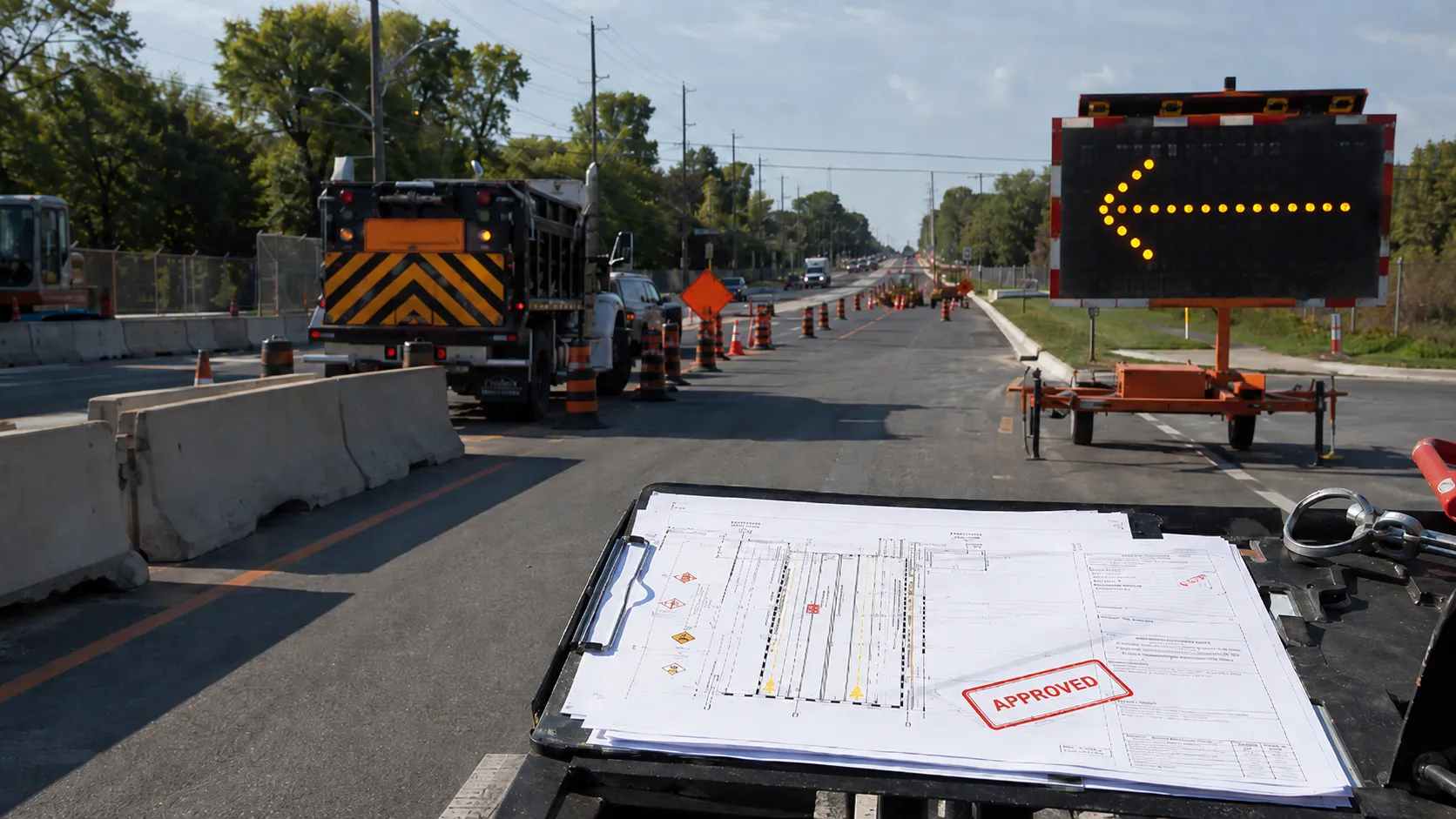
We prepare buildable construction traffic management plans for commercial, industrial, municipal, and heavy civil projects, coordinating site logistics, lane and sidewalk impacts, deliveries, staging, and permit requirements across Toronto, the GTA, and Ontario.
Tell us what you need and we’ll get you a quote. Licensed, insured & WSIB-covered · Free, no-obligation quote & on-site assessment.
Licensed, insured & WSIB-covered · Free, no-obligation quote & on-site assessment.
Built to your engineered drawings, survey, and the real site conditions, not a one-size-fits-all approach forced to fit.
Durable materials and methods chosen for the load, traffic, and environment on site.
Send specs, drawings, or photos and get a free, no-obligation site visit and estimate with no guesswork.
Installation and site work completed in accordance with Ontario requirements.
A construction traffic management plan documents how vehicles, cyclists, pedestrians, transit, deliveries, and construction equipment will move through each project stage. Harrowgate develops plans that match actual heavy civil operations, proposed occupations, and municipal review requirements throughout Toronto and the GTA.
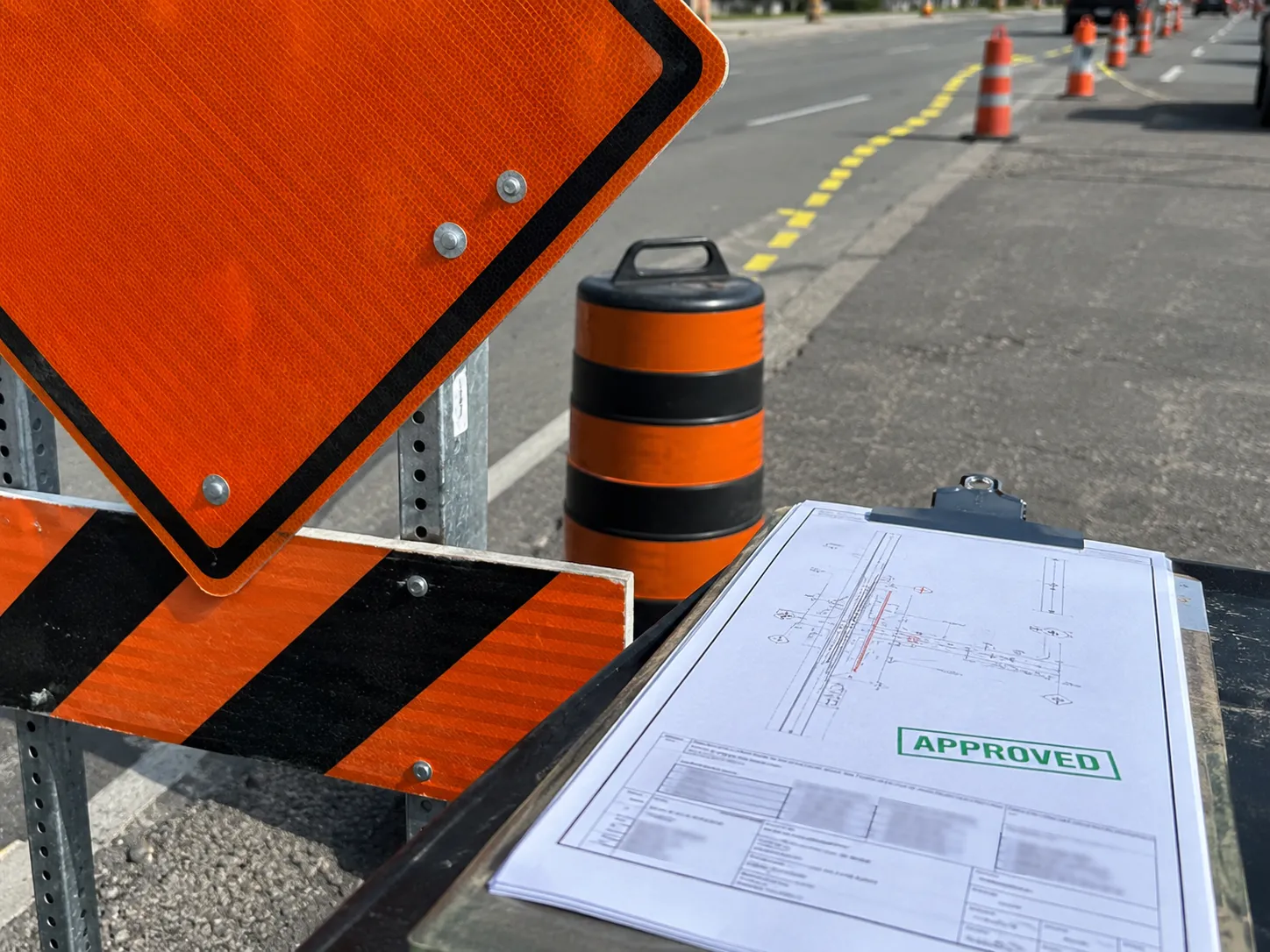
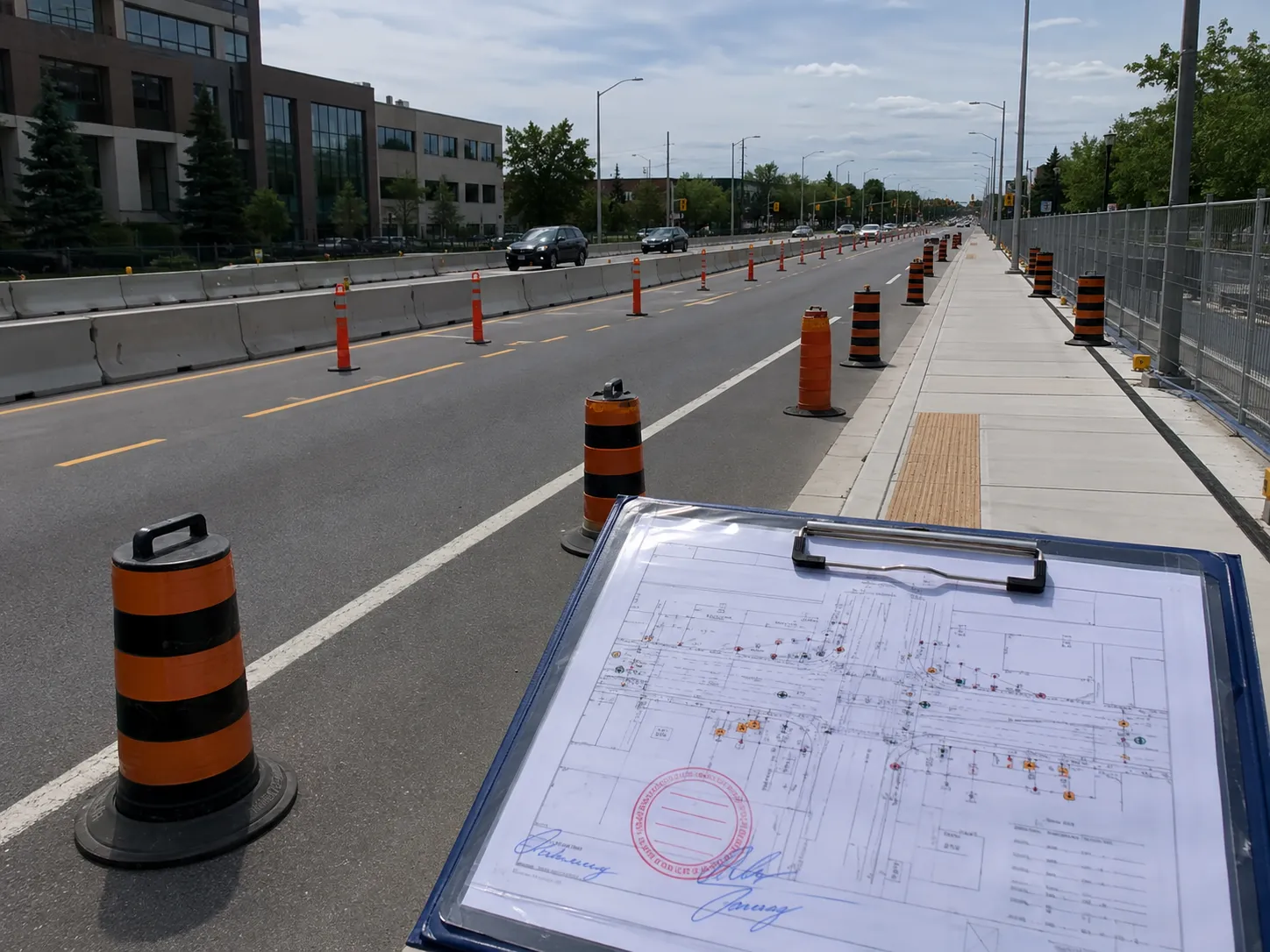
We collect site and roadway data, confirm jurisdiction, model the critical vehicle paths, divide the work into practical stages, select Book 7 controls, and issue a coordinated drawing and narrative. We then support comments, revisions, mobilization, and field verification against the accepted plan.
Truck turning templates are checked at gates and intersections so long vehicles do not track across protected pedestrian space or opposing lanes without control. Each stage identifies the work area, lane widths, tapers, advance warning, barriers, access points, temporary walks, and traffic control person locations. We assess queues and peak restrictions where occupation reduces capacity. Notes define delivery rules, mud tracking response, emergency access, communication procedures, and inspection responsibility. Revision clouds and stage identifiers keep field crews from constructing an outdated arrangement.
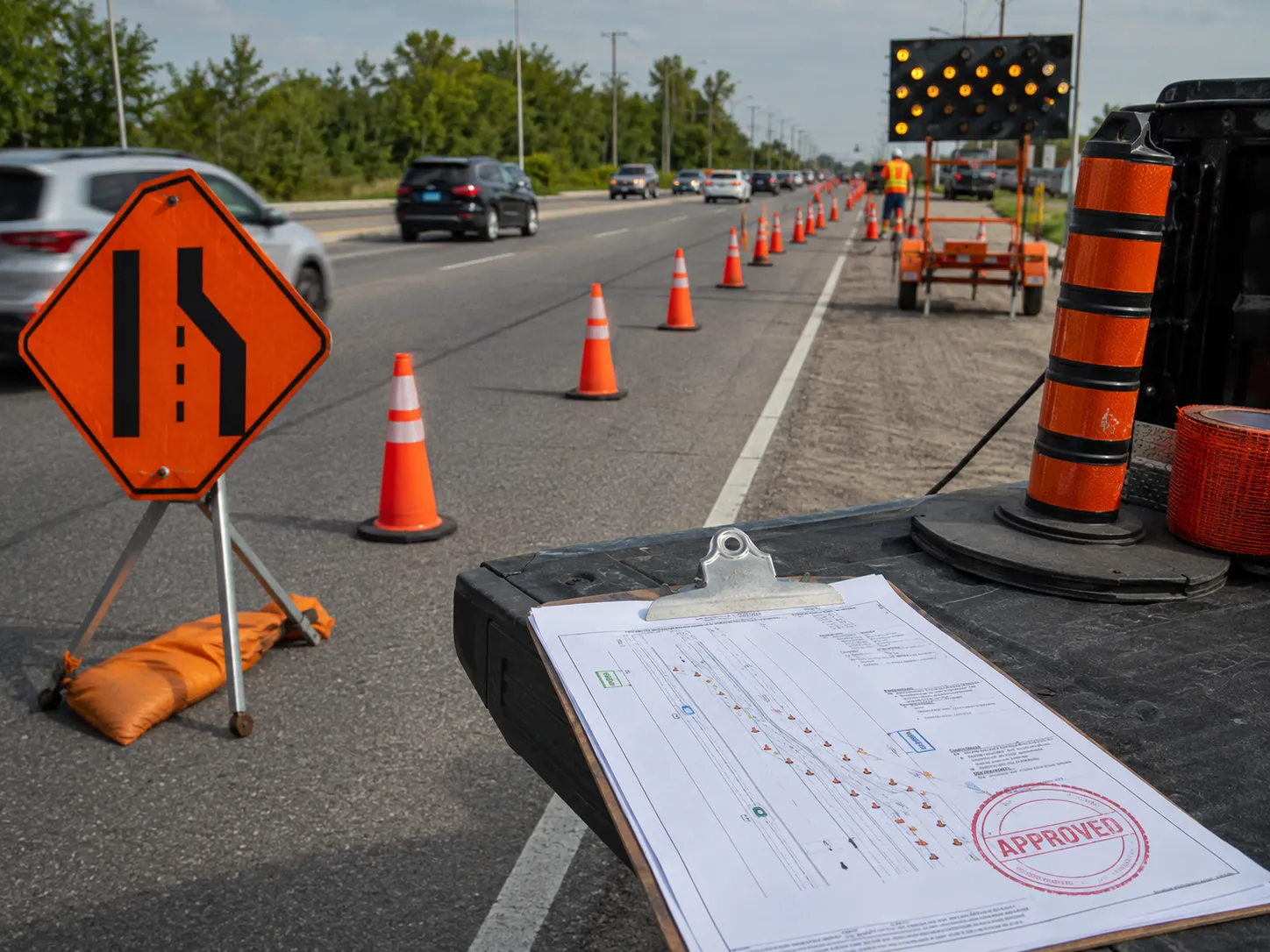
Construction traffic management plans must address Ontario Traffic Manual Book 7 temporary conditions, Ontario Regulation 213/91 traffic protection, applicable OPSS requirements, and every condition imposed by the road authority. Toronto submissions may also support street occupation, construction staging, and road disruption reporting processes.
The drawing scale and sheet size must remain readable in the field. We show dimensions rather than relying on schematic spacing, and identify sign codes, device types, barrier ends, pavement marking changes, loading areas, and accessible routes. Long-duration stages may require temporary signals, signal timing review, transit coordination, paid-duty requirements determined by the authority, or separate cycling details. The plan notes what is existing, what is covered or removed, and what is temporary, preventing contradictory information during inspection.
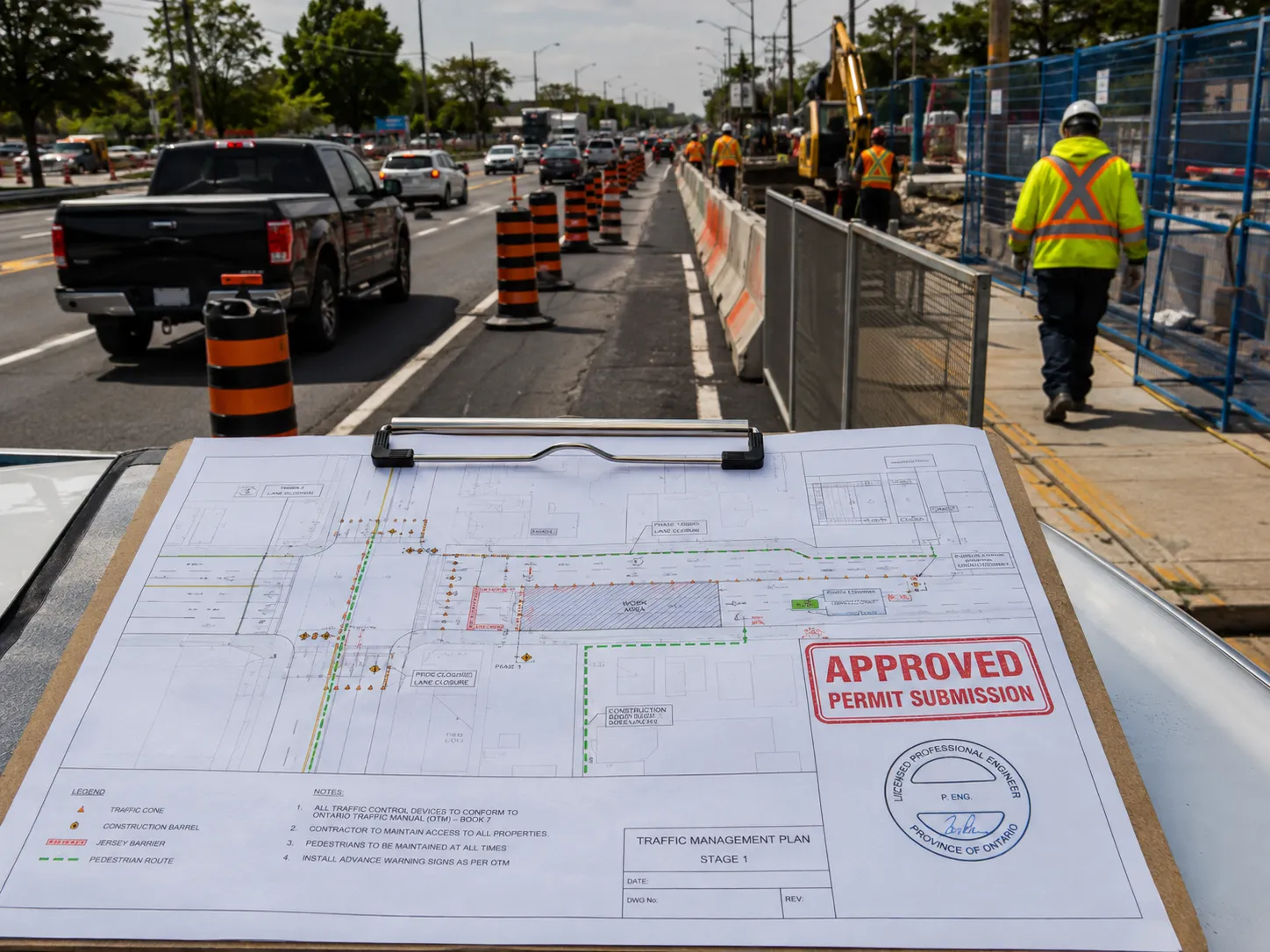
Plans are delayed when they omit dimensions, use a standard layout without site geometry, leave pedestrian or cycling conflicts unresolved, or contradict the construction schedule. Field failures occur when a technically accepted plan cannot accommodate deliveries, excavation support, or safe equipment swing.
We prevent these failures by coordinating early with civil, shoring, demolition, crane, and logistics drawings. A sidewalk diversion that crosses the main truck gate, or a taper that occupies the crane setup area, is corrected before submission. We also check whether the proposed duration triggers a different permit or council approval path. After acceptance, a pre-mobilization walk verifies signs, lane markings, grades, sight distance, and adjacent projects. If site conditions differ, we document the issue and revise instead of forcing the drawing onto the road.
Planning construction traffic management plans? Talk it through with our team.
Traffic management plans are needed when development, demolition, excavation, utility, road, bridge, or facility work affects a roadway, sidewalk, cycling route, laneway, transit operation, or major private access. They are especially important where multiple stages or recurring deliveries change the operating condition.
Typical uses include tower and commercial construction staging, deep excavation, watermain replacement, district energy installation, crane picks, façade work, bridge rehabilitation, industrial shutdowns, and municipal capital projects. Private industrial sites also use plans to separate haul routes from employee parking, loading docks, and emergency lanes. A plan can cover one overnight closure or a multi-year sequence, but each stage must be understandable on its own and tied to dates, work limits, and removal conditions.
Have drawings for construction traffic management plans? Send them over and we will scope it.
A complete plan shows existing road conditions, work and occupation limits, stages, lane widths, signs, tapers, channelizing devices, barriers, sidewalks, cycling routes, transit interfaces, construction gates, truck movements, and access provisions. Notes cover hours, inspections, deliveries, emergency access, maintenance, and the sequence for installing and removing controls.
Toronto can require a plan when construction occupies or affects the public right of way, including roads, sidewalks, boulevards, and lanes. The need and review path depend on the activity, duration, road classification, and staging proposal. Transportation Services identifies submission and permit requirements for the particular location.
No. A Book 7 layout establishes temporary traffic-control principles and device arrangements for a work condition. A construction traffic management plan applies those requirements to surveyed site geometry, construction stages, gates, pedestrian and cycling routes, transit, deliveries, permits, and other project-specific constraints. Both may be required.
Timing depends on jurisdiction, completeness, road classification, closure duration, transit or signal impacts, adjacent projects, and the number of review groups. Major staging or full closures can need more coordination than a short curb-lane occupation. Early submission and a complete, internally coordinated package reduce avoidable review cycles.
Yes, when separate stage drawings clearly show how conditions change and each stage satisfies the applicable controls. A single static sheet rarely covers excavation, structure, enclosure, and restoration adequately. We identify transition steps so the site never sits between stages with obsolete signs or an incomplete pedestrian route.
Useful inputs include current survey or civil base files, site logistics, excavation and hoarding plans, project schedule, road occupancy limits, gate locations, delivery vehicle types, municipal comments, and any earlier permits. Photos and a field walk confirm signs, driveways, transit stops, cycling facilities, and sight-distance constraints.
The constructor and project team must operate the work zone according to applicable law, permit conditions, and the accepted plan. Harrowgate installs, inspects, and adjusts the controls within our scope, coordinates stage changes, and documents field conditions. Material deviations are escalated for approval rather than normalized onsite.
Still have a question about construction traffic management plans? Ask our team directly.
Commercial and heavy-civil construction delivered for developers, contractors, property managers, and municipalities.
Send drawings, a site plan, or a description of the scope. Harrowgate Group is licensed, insured, and WSIB-covered.
Licensed, Insured & WSIB-Covered, work managed and documented on every job
Tell us what you need and we’ll get you a quote. Licensed, insured & WSIB-covered · Free, no-obligation quote & on-site assessment.
Companies We've Worked With
Harrowgate Group delivers commercial and heavy-civil construction for developers, contractors, institutions, municipalities, and property groups across Ontario.
 Popeyes
  Tim Hortons
  Subway
  University of Toronto
  Madison Group
  RioCan
  Women's College Hospital
  Starbucks
  Mazda
Mazda  TD Bank
  City of Toronto Popeyes Tim Hortons Subway University of Toronto Madison Group RioCan Women's College Hospital Starbucks Mazda TD Bank City of Toronto
 Three fields. We reply with the next step.
Thanks, we will call you shortly.
Press Esc to close
Marcus
Project Coordinator