
Brampton Snow Removal Bylaw: The 11 am Rule for Owners
The Brampton snow removal bylaw says owners and occupants must clear sidewalks by 11 am the day after snowfall. Who it covers, the 8 hour order, a checklist.
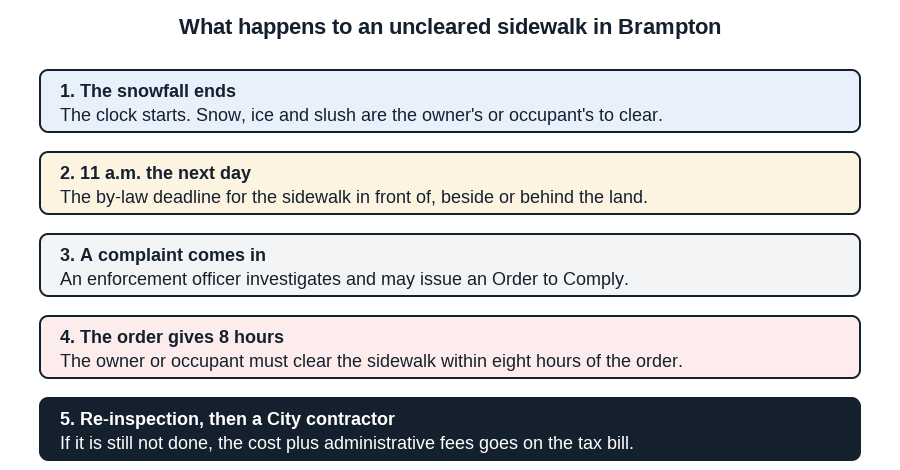
The Brampton snow removal bylaw, Snow and Ice Removal By-law 242-76, requires the owner or occupant of land to clear snow, ice and slush from the sidewalk beside it by 11 a.m. on the day after the snow falls. If it is not done, the City can order the work within eight hours, then send a contractor and add the cost to the property tax bill.
That rule covers a plaza, an industrial yard or an office building the same way it covers a house. This guide explains who has to act, what Brampton clears for itself, how the enforcement steps work and what a property manager should have in place before the first storm. If you want the clearing taken off your hands, see our snow removal page.
What does the Brampton snow removal bylaw actually require?
It requires three things. Under By-law 242-76, the owner or occupant of land must clear snow, ice or slush from the sidewalks on the highways in front of, along the side of or at the rear of the land by 11:00 in the forenoon of the day immediately following the day the snow fell.
Second, where a building fronts or sits close enough to a street that snow or ice may fall onto it, the owner or occupant must have that snow or ice removed from the building forthwith. Third, nobody may remove snow or ice from a building without giving adequate warning to people passing on the street.
| Section | What it says | What it means for a commercial site |
|---|---|---|
| 1 | Owner or occupant clears sidewalks by 11:00 a.m. the day after the snow fell | Every sidewalk edge of the lot, front, side and rear, not only the main entrance |
| 2 | Snow or ice likely to fall from a building onto the street must be removed forthwith | Roof edges, canopies and loading dock overhangs near a street need attention |
| 3 | Adequate warning to passers-by when removing snow or ice from a building | Whoever clears a roof or canopy must warn the street below |
The by-law has one carve-out. Section 5 says it does not apply to the sidewalks on the highways listed in its Schedule A, which runs to three pages and includes Queen Street, Main Street, Steeles Avenue, Williams Parkway and Bramalea Road. That lines up with the City's own list of sidewalks it clears.
Does the bylaw apply to businesses, plazas and industrial sites?
Yes. By-law 242-76 refers to the owner or occupant of land and makes no exception for commercial or industrial property, so a landlord and a tenant can both be responsible for the same frontage.
Two other rules reach commercial sites. Brampton's Property Standards By-law 165-2022, in section 12.3, says every walkway and access route to a building that is accessible to the general public must be kept free from ice and snow after a snowfall. And Ontario's Occupiers' Liability Act, section 3(1), says an occupier of premises owes a duty to take such care as is reasonable in all the circumstances to see that people entering the premises are reasonably safe while on them.
Put together, the sidewalk deadline is the City's rule, the walkway rule applies inside your property line, and the Act is the standard a court would apply if someone is hurt. We do not give legal advice, so ask your lawyer or insurer how these fit your lease and your contract. Our page on commercial snow removal describes the clearing side.
What does Brampton clear, and what is left to you?
The City clears arterial roads and certain sidewalks. Everything else is the owner's job. According to the City of Brampton's winter levels of service page, the City maintains sidewalks that are on arterial roads, in front of City parks and recreation facilities, curb faced with no grass boulevard, behind a property (reverse frontage), or at Brampton Transit and Züm stop locations.
| Item | Who is responsible | The City's stated standard |
|---|---|---|
| Arterial and collector roads | The City | Arterials to bare pavement; roads safe and passable within 24 hours after snowfall ends, or 48 hours after a significant event |
| Local streets and courts | The City | Plowed when 5 cm or more falls in one storm; not plowed to bare pavement |
| Sidewalks on the City's list above | The City | Within 24 hours after the end of a snowfall where possible |
| All other sidewalks | The owner or occupant | Clear by 11 a.m. the day after snowfall |
| Windrow at the bottom of a driveway | The owner | The City does not return to remove it |
| Private parking lots and drive aisles | The owner or occupant | The levels of service page sets standards for City facility lots only |
One fact is worth quoting on its own: the City's published service level for local streets is to plow them once in a storm that brings at least 5 cm of snow, and it says not to expect bare pavement on local streets all winter. Do not plan your site access around the City's plow reaching your street quickly.
What is the penalty if the sidewalk is not cleared on time?
It starts with an order, not a fine. According to the City's sidewalk snow clearing page, when it receives a complaint about a sidewalk that is not cleared, an officer investigates and may issue an Order to Comply that gives the owner or tenant eight hours to clear it.
The City then re-inspects. If the work is still not done, it arranges a contractor and adds the cost of the work, plus administrative fees, to the owner's property taxes. Section 4 of By-law 242-76 says the same: the City may cause the snow to be removed and the cost is added to the owner's tax bill.
Penalties also exist alongside that. Section 7 of the by-law applies the City's administrative penalties by-law, 218-2019, and the City announced that its administrative fines for snow clearing, parking and property standards rose on January 1, 2026. The fine amounts rise for repeat offences, and we leave the exact figures to the City's published schedule so they cannot go stale here. Check the current numbers with the City before you set a budget or a reserve.
How much time does a property really have? A worked example
Less than a day, and often much less. This is a hypothetical example, not a real site. Suppose snow stops falling at 9 p.m. on a Tuesday. The 11 a.m. deadline on Wednesday is 14 hours later. If the snow stops at 3 a.m. Wednesday, the City's wording, 11 a.m. the day after the end of a snowfall, would put the deadline at 11 a.m. Thursday, while the by-law's own wording refers to the day after the day the snow fell.
The two readings can differ when a storm runs past midnight. If you are not sure which one an officer would apply, plan to the earlier deadline and confirm with 311. The safest assumption for a property manager is that the clock starts when the snow stops, and the first morning is the one that counts.
What about snow you have already cleared?
Where you put it matters as much as when you clear it. The City says it does not want snow shovelled or pushed onto the road, because it creates a hazard for vehicles and can block catch basins and create a flooding risk. The City's by-law enforcement page treats pushing snow onto the roadway as dumping.
On a commercial lot, that means piling snow on site with room to spare, away from drive aisles, hydrants and catch basins, or arranging for it to be taken away. The City also asks owners to clear snow from around fire hydrants on their property. When a lot runs out of storage, our snow hauling and off-site removal page explains what hauling involves, and our snow volume calculator gives a rough volume from the area and depth you enter.
What should a property manager have in place before the first storm?
Have a named person, a written scope and a record for each storm. The checklist below comes from the public rules above.
- List every sidewalk edge of the property, front, side and rear, and mark which ones are on the City's list of sidewalks it clears.
- Write down who is responsible for each: the owner, the tenant or a contractor, and put it in the lease or contract.
- Check the walkways and entrances the public uses, because the Property Standards By-law applies to them too.
- Choose where snow will be stored on site, away from hydrants, catch basins and drive aisles.
- Look at roof edges, canopies and loading docks that overhang a street, because section 2 of the by-law covers snow falling from a building.
- Keep the City's contacts handy: 311 and enforcement@brampton.ca.
- Check the City's Brampton Plow Tracker to see whether a street or sidewalk has been serviced.
- Decide before December whether you want a seasonal arrangement, not a call during the storm. See our page on sidewalk and walkway snow clearing.
Why does ice matter as much as snow?
Because the by-law says snow, ice or slush. A sidewalk shovelled to the concrete in the morning can freeze over again by evening, and a walkway the public uses must stay free from ice and snow under the Property Standards By-law. Surface condition is part of the duty, so plan for repeated passes, not one visit.
What should you send for a written quote?
Send the site address, a plan or a photo showing every sidewalk edge and entrance, the size of the parking lot and where snow can be stored. Tell us which parts the City clears and which parts are yours. Send us the details and we will reply with options for a written quote, or start from our snow removal page.
Planning a project in the same city? Our analysis of commercial and industrial permits in Mississauga shows how much work in that city is alterations to buildings that already stand, and our guide to winter concrete pouring in Ontario explains what cold weather does to site work. For a city with a very different split of duties, see our guide to the Markham snow removal bylaw, where the City plows its sidewalks.
Frequently asked questions
When must I clear my sidewalk under the Brampton snow removal bylaw?
By 11:00 in the morning on the day after the snow fell. Snow and Ice Removal By-law 242-76 puts that duty on the owner or occupant of the land, for the sidewalk in front of, beside or behind it. Clear snow, ice and slush, not just the snow.
Does the bylaw apply to a business or a plaza, not just a house?
Yes. The by-law speaks of the owner or occupant of land, with no exception for commercial or industrial property. The City's Property Standards By-law 165-2022 adds that every walkway and access route to a building that the public can use must be kept free of ice and snow after a snowfall.
What happens if the sidewalk is not cleared?
After a complaint, an enforcement officer can issue an Order to Comply that gives eight hours to clear it. If it is still not done at re-inspection, the City arranges a contractor and adds the cost, plus administrative fees, to the owner's property taxes. Penalties are also set under the City's administrative penalties by-law.
Can I push snow from my parking lot onto the street?
No. The City asks owners not to shovel or push snow onto the road because it creates a hazard for vehicles and can block catch basins and cause flooding. If a lot is larger than your sidewalk and driveway needs, plan where the snow will be stored or hauled before the first storm.
Does Brampton clear any sidewalks itself?
Yes, some. The City maintains sidewalks on arterial roads such as Queen Street and Bramalea Road, in front of City parks and recreation facilities, curb faced sidewalks with no grass boulevard, sidewalks behind a property, and sidewalks at Brampton Transit and Züm stops. Everything else is the owner's job.
Who do I call to report an uncleared sidewalk or ask about the by-law?
Call the City's 311 line or email enforcement@brampton.ca. The City's own pages give these as the contacts for reporting a sidewalk that has not been cleared by 11 am the day after a snowfall and for questions about the by-law.
Get a quote for your project
Tell us about the site, the scope, and your timeline. We review it and reply with the next step.