
Built to spec
Built to your engineered drawings, survey, and the real site conditions, not a one-size-fits-all approach forced to fit.
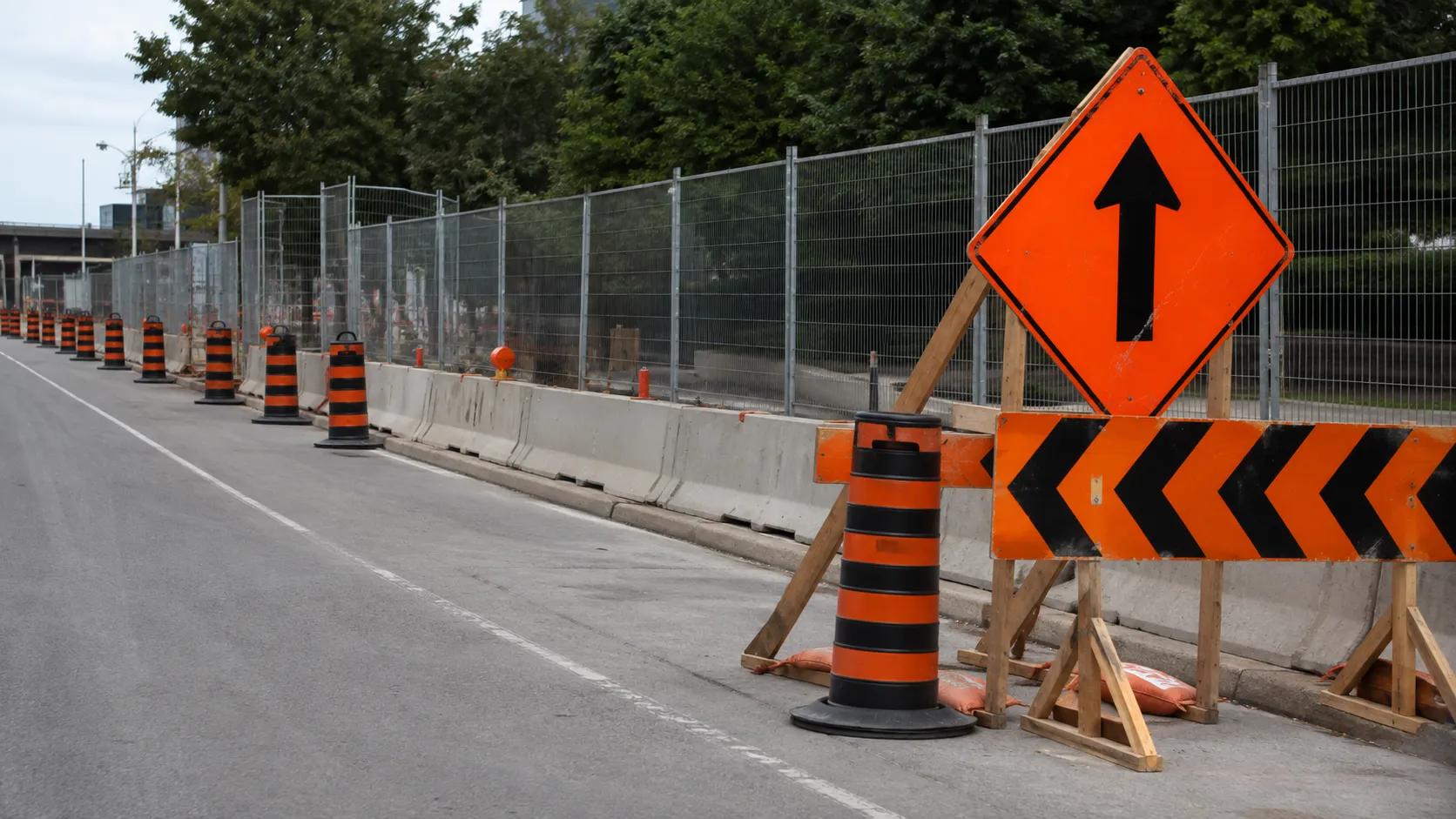
We supply, install, inspect, reset, and remove temporary construction signs, channelizing devices, and barricades for commercial, industrial, municipal, and heavy civil projects across Toronto, the GTA, and Ontario, matching every device to the approved traffic plan.
Tell us what you need and we’ll get you a quote. Licensed, insured & WSIB-covered · Free, no-obligation quote & on-site assessment.
Licensed, insured & WSIB-covered · Free, no-obligation quote & on-site assessment.
Built to your engineered drawings, survey, and the real site conditions, not a one-size-fits-all approach forced to fit.
Durable materials and methods chosen for the load, traffic, and environment on site.
Send specs, drawings, or photos and get a free, no-obligation site visit and estimate with no guesswork.
Installation and site work completed in accordance with Ontario requirements.
Construction signage and barricades warn road users, define the route, close unsafe space, and separate traffic from active work. Harrowgate installs complete temporary-device systems for roadway, sidewalk, industrial, and site-access conditions throughout Toronto and the GTA, then keeps them aligned with the current stage.
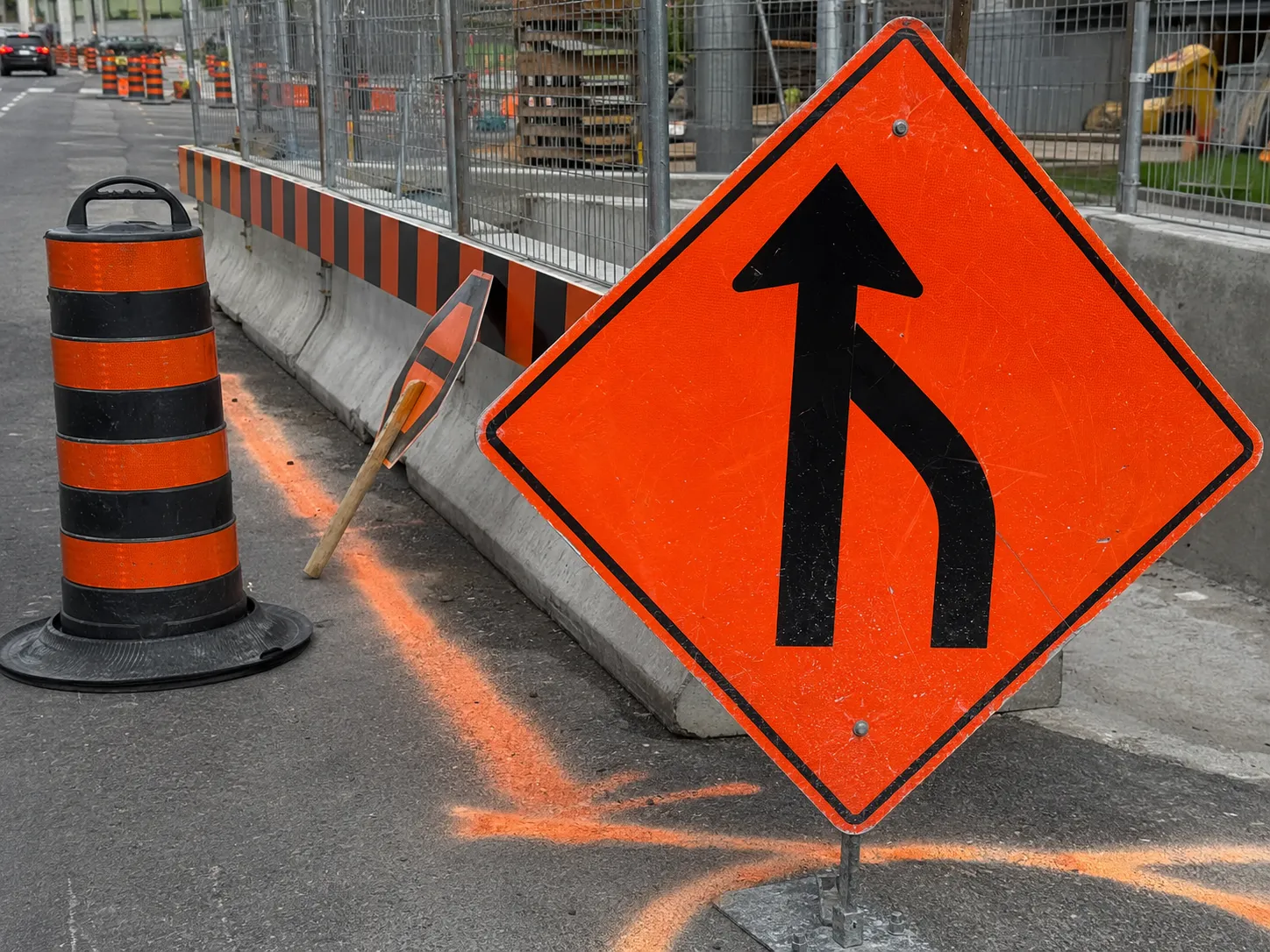
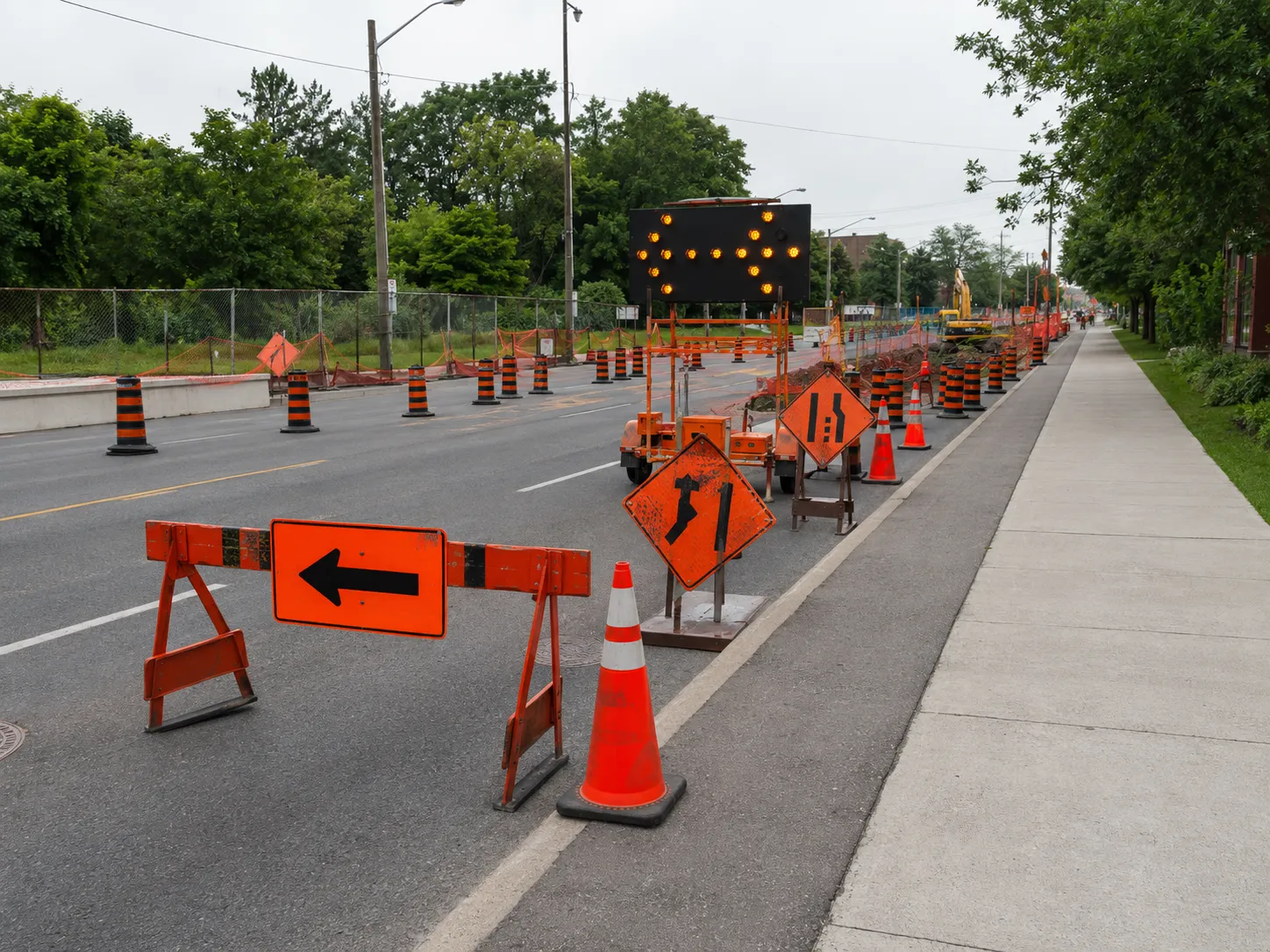
We verify the approved plan, inventory and inspect devices, mark locations, install signs and channelization in a protected sequence, secure each component for expected exposure, and complete a drive-through and walk-through before work starts. Inspections continue for the life of the setup.
Signs are oriented for visibility without facing unrelated approaches. Bases and supports are chosen for duration, wind, traffic exposure, and surface conditions, without creating a new trip or impact hazard. Channelizing devices are spaced consistently so the line does not invite weaving. Barricades are placed at the actual closure point with enough advance guidance to prevent last-second turns. We clean, replace, straighten, or relocate devices after weather, construction activity, or a vehicle strike, and remove obsolete signs at each stage transition.
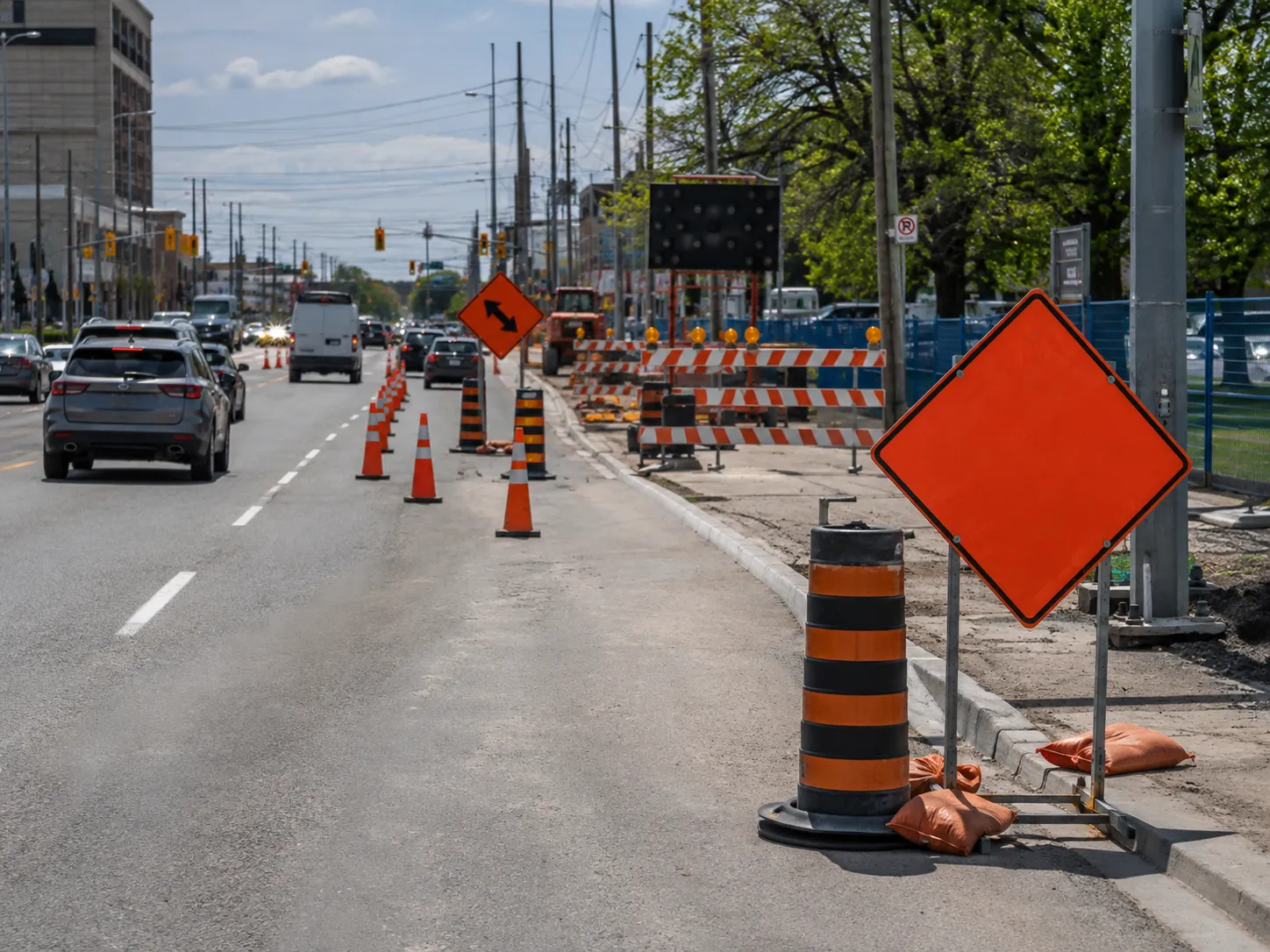
Temporary signs and barricades are selected and placed under the applicable Ontario Traffic Manual Book 7 plan, Ontario Regulation 213/91, OPSS requirements, contract documents, and road-authority conditions. Device type, sign code, retroreflectivity, support, spacing, and placement must match the approved temporary condition.
Long-duration and higher-speed applications generally require more robust delineation than a brief low-speed task. Temporary barrier, when specified, is an engineered system with connection, anchorage, end treatment, and deflection requirements that cannot be replaced by barricades. Toronto permits can require drawings showing all new and existing signs affected by the occupation. We maintain an installation that remains legible in rain, darkness, snow, and changing construction backgrounds, with lighting where the accepted design calls for it.
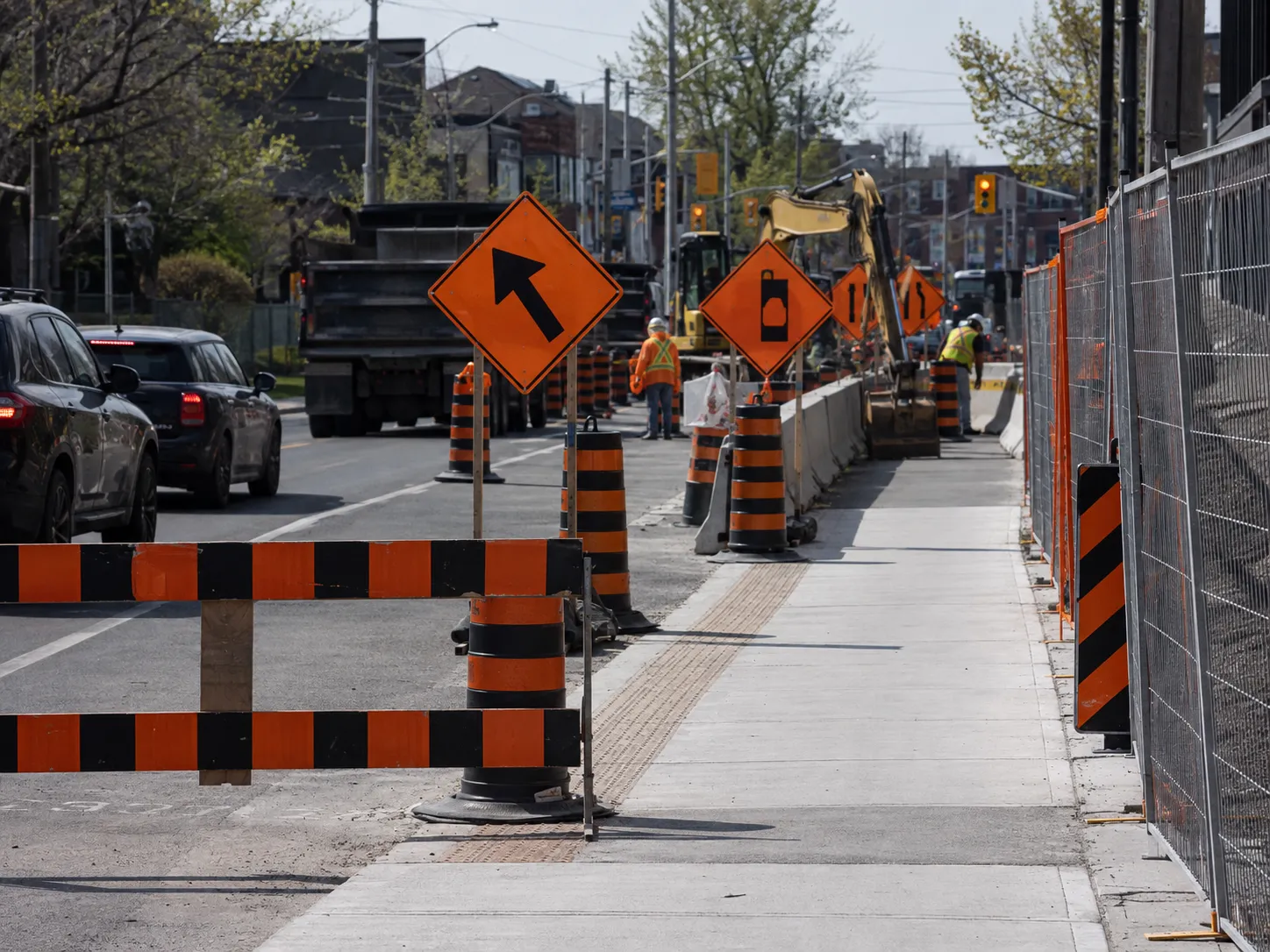
Temporary controls become dangerous when signs are hidden, turned, dirty, contradictory, or left after the condition ends, and when cones or barricades drift until the path is no longer obvious. We prevent these failures through correct support, repeated inspection, stage control, and immediate device replacement.
A generic ROAD CLOSED sign without advance route information can trap trucks at a point where they cannot turn. A sidewalk barricade with an open edge can lead pedestrians into the roadway. A gap in channelization can become an unintended access point.
We trace these failure paths before opening the setup. Device storage is also controlled so unused signs are covered or faced away from traffic. During snow operations, the line is reset and drainage paths are kept from redirecting water or ice through the travel route.
Planning construction signage and barricades? Talk it through with our team.
Temporary signs and barricades support lane closures, detours, sidewalk diversions, excavation, demolition, utility work, drilling, concrete placement, crane operations, loading, site gates, industrial shutdowns, and emergency repairs. The device package is scaled to traffic exposure, duration, geometry, and the hazard being controlled.
On public roads, the setup guides people through a regulated temporary condition. Inside a facility, it can separate employees and visitors from mobile equipment, cleaning work, or dismantling. At a development site, devices manage truck entry and prevent public access to hoarding openings. We also handle progressive staging where a work zone advances or switches sides. Every move includes removal of the old message, installation of the new line, and verification that no ambiguous path remains.
Have drawings for construction signage and barricades? Send them over and we will scope it.
We install temporary warning and regulatory signs, cones, drums, delineators, barricades, arrow displays, fencing, and other plan-specified devices. Where the design requires temporary concrete barrier, markings, lighting, or specialized systems, we coordinate and install the defined components. The accepted plan determines the correct combination.
A barricade provides visual closure or channelization and is not assumed to stop an errant vehicle. Temporary traffic barrier is an engineered physical-separation system with defined connections, deflection, anchorage, transitions, and end treatment. One cannot be substituted for the other without design and road-authority acceptance.
We use plan-compliant retroreflective devices, correct sign orientation, stable supports, clean faces, and supplemental lighting where required. Night inspections check the setup from the approaching road-user perspective. Headlight glare, work lighting, rain, snow, parked vehicles, and bright commercial backgrounds can all reduce effective visibility.
They are checked after installation, throughout the shift at a frequency suited to exposure, after stage changes, and after wind, snow, impacts, or construction activity that may move them. A device that no longer communicates the approved route is corrected promptly, not left until the next scheduled visit.
Only where the approved arrangement and municipal conditions permit placement without creating an obstruction or accessibility barrier. Supports must be stable and positioned outside the required clear route. If the sidewalk cannot accommodate the device and users safely, the plan needs a different mounting or routing solution.
Provide the accepted traffic plan, permit conditions, installation and removal dates, road speed and classification, work hours, stages, and any barrier, marking, lighting, or inspection requirements. A device count alone is insufficient if sign codes, support method, spacing, and field geometry have not been resolved.
The project’s traffic-control procedure defines reporting and responsibilities. Within our scope, Harrowgate responds, restores the accepted setup, records the condition, and escalates damage that affects barrier integrity or plan compliance. Work may pause if the strike removes protection and the safe operating envelope cannot be immediately re-established.
Still have a question about construction signage and barricades? Ask our team directly.
Commercial and heavy-civil construction delivered for developers, contractors, property managers, and municipalities.
Send drawings, a site plan, or a description of the scope. Harrowgate Group is licensed, insured, and WSIB-covered.
Licensed, Insured & WSIB-Covered, work managed and documented on every job
Tell us what you need and we’ll get you a quote. Licensed, insured & WSIB-covered · Free, no-obligation quote & on-site assessment.
Companies We've Worked With
Harrowgate Group delivers commercial and heavy-civil construction for developers, contractors, institutions, municipalities, and property groups across Ontario.
 Popeyes
  Tim Hortons
  Subway
  University of Toronto
  Madison Group
  RioCan
  Women's College Hospital
  Starbucks
  Mazda
Mazda  TD Bank
  City of Toronto Popeyes Tim Hortons Subway University of Toronto Madison Group RioCan Women's College Hospital Starbucks Mazda TD Bank City of Toronto
 Three fields. We reply with the next step.
Thanks, we will call you shortly.
Press Esc to close
Marcus
Project Coordinator