
How Does French Drain Work? An Ontario Guide to Drainage
How does French drain work? A stone filled trench with a perforated pipe collects groundwater and carries it to a safe outlet. Parts, Ontario rules, limits.

How does French drain work? A French drain is a trench filled with clean crushed stone around a perforated pipe, wrapped in filter fabric. Water in the soil enters the stone and the pipe, and gravity carries it along the pipe to an outlet such as a storm sewer, ditch, dry well or sump pit in Ontario.
That simple answer hides the parts that decide whether a drain works for years or silts up in two. This guide explains each part, the Ontario Building Code and Toronto rules that apply, what a French drain cannot do, and what to have ready when you ask for a quote. If you want a drain designed and installed on a commercial site, see our French drain installation service.
What are the parts of a French drain?
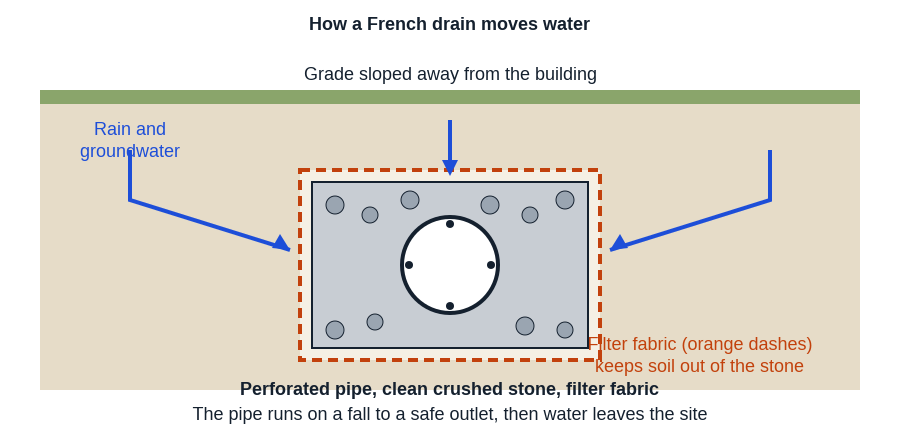
A French drain has four working parts: a trench with a fall, filter fabric, clean crushed stone and a perforated pipe, plus an outlet. Take any one away and the drain either fills with soil or holds water instead of moving it.
| Part | What it does | What goes wrong without it |
|---|---|---|
| Trench with a fall | Gives the water somewhere lower to travel to | Water sits in the pipe and the stone and the drain acts like a long puddle |
| Filter fabric | Lets water through and holds fine soil back | Silt moves into the stone and slowly closes the voids |
| Clean crushed stone | Gives water an open path and holds the trench shape | Water cannot move freely and the drain loses capacity |
| Perforated pipe | Collects water from the stone and carries it along the trench | The stone alone cannot carry large flows over a distance |
| Outlet | Lets the water leave the site safely | The drain backs up, or the water goes where it causes a new problem |
How does the water actually move?
Water moves into a French drain because stone and pipe give it an easier path than the soil around them. Rain soaks into the ground, travels sideways and down, reaches the open stone, and drops into the perforations in the pipe. Gravity then carries it along the pipe to the outlet.
The drain does not suck water out of the ground. It is a low, open channel that water finds on its own, and it only works when the pipe runs downhill to an outlet that is lower than the pipe. In soil that is already saturated, the drain keeps the water table from rising to the footing or the slab. The ground still gets wet, but the water is led away instead of pooling.
What does the Ontario Building Code say about drains like this?
The term French drain does not appear in Part 9 of the Building Code, but its foundation drain rules describe the same build. Under Section 9.14 of the 2024 Building Code compendium, drain pipe for foundation drainage must not be less than 100 mm in diameter (Article 9.14.3.2).
The same section says the top and sides of the pipe must be covered with not less than 150 mm of crushed stone or other coarse clean granular material containing not more than 10 percent of material that passes a 4 mm sieve (Article 9.14.3.3). That "not more than 10 percent" limit is the Code's way of keeping fine soil out of the drainage stone, which is the reason filter fabric and clean stone matter.
Part 9 is written for housing and small buildings. Larger commercial buildings are designed by an engineer, and that design sets the drain and its outlet. Use the Code values as a reference point for how a proper drain is built, and confirm the rules for your own building with your engineer and your municipality.
Where does a French drain empty?
A French drain must empty to a place that can take the water. Article 9.14.5.1 says foundation drains shall drain to a sewer, drainage ditch or dry well. Where gravity cannot do the job, Article 9.14.5.2 calls for an automatic sump pump to lift the water out of a sump pit into one of those places.
- Storm sewer or ditch: the simplest outlet when the pipe can reach it on a fall and the owner of the sewer or ditch allows the connection.
- Dry well: allowed only where natural groundwater is below the bottom of the dry well, and the Code says it must be not less than 5 m from the building foundation (Article 9.14.5.3).
- Sump pit and pump: a sump pit must be not less than 750 mm deep and 0.25 m2 in area, with a cover (Article 9.14.5.2). It is the answer when the lowest point of the drain is below any outlet.
- Not the sanitary sewer: the City of Toronto's Foundation Drainage Policy says long term discharge of foundation drainage to the sanitary sewer system is not permitted, and long term means more than 12 months (Policy statement 4.1, amended October 1, 2026).
Surface water has its own rule. Article 9.14.6.1 says a building site must be graded so that water will not accumulate at or near the building and will not adversely affect adjacent properties. A drain that moves your water onto a neighbour's lot breaks that principle, and it is a common source of disputes.
Toronto's sewer rules are specific, as the policy above shows. Other municipalities have their own sewer use by-laws, so confirm the allowed outlet with your own city before the trench is dug.
When does a French drain help, and when does it not?
A French drain helps where groundwater or shallow runoff collects against a building, a retaining wall, a slab edge or a low spot. It does not fix a leak that comes through a wall under pressure, or water that has no outlet to go to.
| Situation | French drain suits it? | Why |
|---|---|---|
| Wet soil beside a retaining wall | Yes | Drained backfill relieves water pressure behind the wall |
| Seepage at the edge of a slab or parking area | Often | An edge drain intercepts water before it reaches the base |
| Water coming through a foundation wall | Not on its own | The wall may need exterior waterproofing as well as drainage |
| Standing water with no lower outlet | Only with a sump and pump | Gravity has nowhere to carry the water |
| Surface runoff over pavement | Usually no | A catch basin or storm inlet is built for that |
Is a French drain the same as exterior waterproofing?
No. Drainage moves water away. Waterproofing stops water from entering the wall. A wet foundation can need both, and our below grade waterproofing work is the answer when the wall itself is leaking. Water that keeps coming back is also one of the signs we discuss in signs a commercial foundation needs repair. To see how a yard drain differs from the foundation drain at the footing, read our guide to French drain vs weeping tile.
Do retaining walls need one?
Water pressure behind a wall is a common cause of leaning and cracking, so drained backfill and an outlet are part of every wall design. Our guide to blocks for retaining wall projects shows where the drain sits behind each wall type.
Why do French drains fail?
French drains fail when fine soil gets into the stone and pipe, when the pipe has no fall or is crushed, or when the outlet is blocked. Each cause comes back to a choice made at installation, not to age.
- Soil mixing with the stone. The Code expects this risk on wet sites. Article 9.14.4.4 says where soil becomes mixed with granular drainage material because of wet site conditions, enough additional granular material shall be provided so that the top 125 mm are kept free of soil.
- Dirty or wrong stone. Stone with many fines packs down and closes the voids. The Code's 10 percent limit on material passing a 4 mm sieve exists for this reason.
- No fall. A pipe that sags or runs flat holds water. A drain depends on a continuous slope to the outlet.
- A blocked or frozen outlet. A drain that cannot leave the site backs up behind the blockage.
- No access. Without a cleanout, roots and silt are hard to find and hard to flush.
What should be checked before the trench is dug?
Locate everything buried before the excavation starts. A trench beside a building or a slab runs close to services, footings and sometimes post tension cables, so we use GPR concrete scanning where a slab is involved, and the excavation follows the locates. Toronto also treats downspouts as part of the same system: its basement flooding page says disconnecting downspouts from the sewer system is mandatory, so roof water should not be adding to the drain's load through a pipe that should have been disconnected.
Read the City of Toronto's basement flooding guidance for the causes it lists, which include a failed weeping tile system and a failed sump pump. If the real problem is surface water running over pavement toward an inlet, a catch basin repair and replacement job may be the better fix.
What should you have ready for a quote?
- A site plan showing the building, the wet area and the nearest possible outlet.
- The grade at the wet area and at the outlet, so the fall can be checked.
- Photos or notes on when the water appears: after rain, after thaw, or all year.
- Any geotechnical report, survey or earlier drainage drawing.
- What sits above the drain: lawn, pavement, a slab or a wall.
- The municipality, so the allowed outlet can be confirmed first.
Have a wet site you need drained? Send us the plan and your photos and we will respond with options for a written quote, or start from our French drain installation page.
Frequently asked questions
Where does a French drain empty?
It empties to a place the water can safely leave: a storm sewer, a drainage ditch, a dry well, or a sump pit with a pump. Under the Ontario Building Code, foundation drains drain to a sewer, drainage ditch or dry well. The outlet must never send water onto a neighbour's property or into a sanitary sewer.
How is a French drain different from weeping tile?
Both are perforated pipe in clean stone, so they work the same way. Weeping tile is the foundation drain that sits at the footing and is required by the Building Code unless it can be shown to be unnecessary. A French drain is the same idea used in the yard or beside a wall to intercept water before it reaches the building.
Does a French drain need a sump pump?
Only when gravity cannot carry the water to an outlet. If the pipe has enough fall to reach a storm sewer, ditch or dry well, no pump is needed. If the lowest point of the drain is below the outlet, the water collects in a sump pit and an automatic pump lifts it out.
Can a French drain connect to the sanitary sewer in Toronto?
No for long term use. The City of Toronto's Foundation Drainage Policy, amended on October 1, 2026, states that long term discharge of foundation drainage to the sanitary sewer is not permitted, and it defines long term as more than 12 months. Ask the city or your engineer which outlet is allowed for your site.
Why do French drains stop working?
Most fail because fine soil gets into the stone and pipe, the pipe has no fall or is crushed, or the outlet is blocked or frozen. Clean stone with few fines, filter fabric and a clear outlet are what keep a drain working. Roots and silt make a drain with no cleanout hard to inspect.
Get a quote for your project
Tell us about the site, the scope, and your timeline. We review it and reply with the next step.