
Shoring vs Underpinning: Which Does Your Project Need?
Understand the difference between shoring and underpinning, when Ontario commercial projects need each, and why some excavations require both systems.
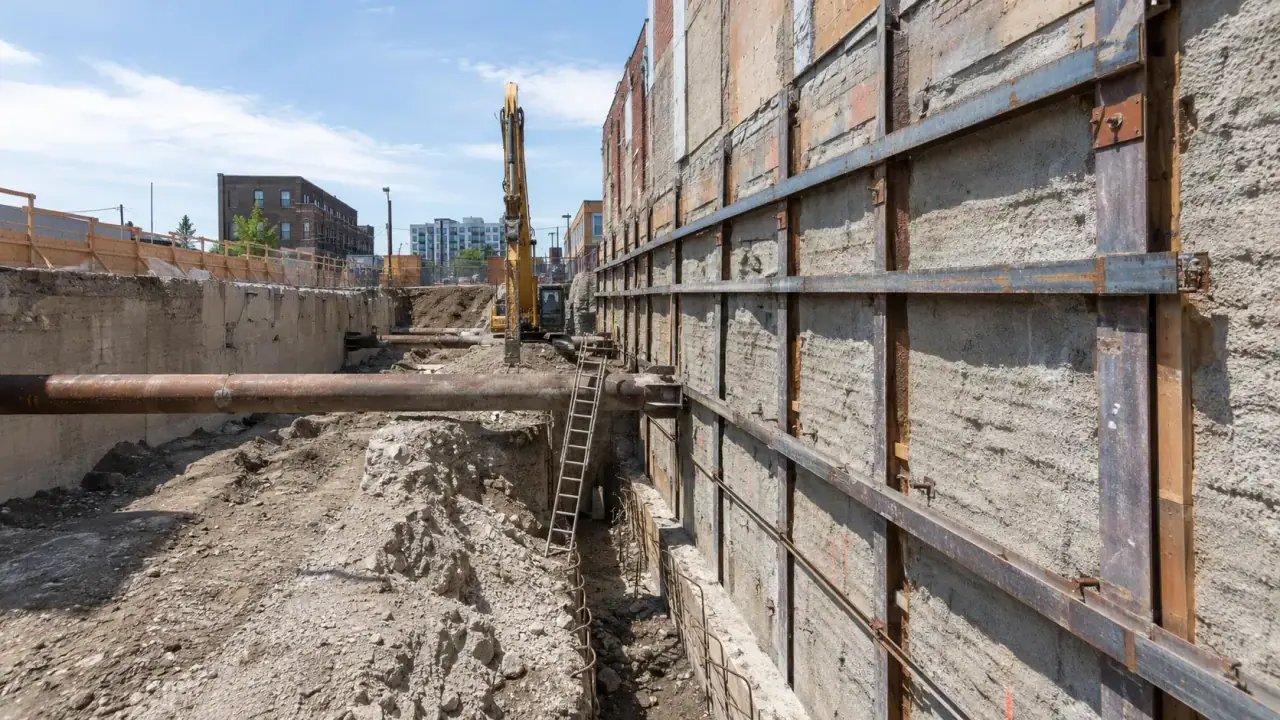
Shoring temporarily supports soil, an excavation, or a structure while work proceeds. Underpinning permanently strengthens or deepens an existing foundation so loads transfer safely to improved bearing. A project may need shoring, underpinning, or both. The decision belongs to the project engineer after reviewing excavation depth, soil, groundwater, adjacent foundations, loads, access, and movement tolerance.
By Harrowgate Group
Last updated: July 24, 2026
The terms are sometimes used interchangeably on early budgets, but they solve different problems. Shoring controls temporary instability and protects the work zone or neighbouring assets. Underpinning changes how an existing building is supported. Neither should be selected from depth alone.
Shoring vs underpinning: what is the difference?
| Item | Shoring | Underpinning |
|---|---|---|
| Primary purpose | Temporary excavation or structural support | Permanent foundation strengthening or deepening |
| Typical systems | Soldier piles and lagging, sheet piles, secant walls, braces | Sequenced mass concrete, beams, micropiles, piles |
| Design focus | Earth, water, surcharge, movement, sequence | Existing loads, bearing, settlement, load transfer |
| Common trigger | Deep excavation or limited layback | Excavation below adjacent footing or inadequate foundation |
| End state | May be removed or abandoned | Becomes part of permanent support |
What affects shoring and underpinning most?
Adjacent foundation elevation
If the proposed excavation extends below the influence zone of a neighbouring footing, permanent support may be required in addition to excavation retention.
Soil and groundwater
Loose fill, soft soil, water pressure, seepage, and variable layers change both temporary loading and the feasible installation method.
Movement sensitivity
Masonry, façades, utilities, slabs, rail lines, and occupied buildings can have very low tolerance for settlement or lateral movement.
Access and sequence
Low headroom, property lines, vibration limits, buried services, and the need to keep operations running can rule out otherwise common systems.
What do Ontario rules and current data say?
Ontario’s excavation guidance cites soil classification, sloping, shoring, engineered systems, water removal, utility locations, and unstable adjacent structures as required planning considerations. Source: Ontario excavation hazards guidance, accessed July 2026.
Ontario Regulation 213/91 defines engineered support systems and sets requirements for excavation support, worker entry, soil classification, and professional engineering in prescribed conditions. Source: Ontario Regulation 213/91, Construction Projects, current July 2026.
How should you plan shoring and underpinning?
- Investigate the site. Obtain surveys, utility records, geotechnical information, test pits where appropriate, and accurate adjacent footing elevations.
- Set movement criteria. The engineer should define design loads, acceptable movement, groundwater assumptions, monitoring points, and response thresholds.
- Design the sequence. Coordinate excavation lifts, underpinning pins, lagging, bracing, tiebacks, dewatering, concrete work, and inspections.
- Monitor and close out. Collect baseline readings, review movement during work, respond to trigger levels, and preserve as-built records.
What problems should owners watch for?
- Excavating before support is ready: Removing soil changes the load path immediately and can cause movement before a delayed correction is possible.
- Assuming neighbouring footings: Drawings may be missing or inaccurate, especially on older properties and additions.
- Ignoring water: A system designed only for dry earth pressure may perform poorly when groundwater or perched water appears.
For shoring and underpinning, Harrowgate Group’s trust baseline is 20 years in business, licensed, insured, and WSIB-covered.
Frequently asked questions
Can shoring replace underpinning?
Not when the permanent foundation load needs to be transferred deeper or strengthened. Shoring may protect the excavation while underpinning is installed, but it does not automatically solve the permanent load path.
Can underpinning be temporary?
Underpinning is generally designed as permanent foundation support. Temporary needles, shores, or jacks may be part of its installation sequence.
Does every deep excavation need shoring?
No. Some sites have enough room and suitable soil for engineered sloping or benching. Tight property lines and adjacent assets often make a support system necessary.
Who designs shoring and underpinning?
A professional engineer with relevant geotechnical and structural information should design and review the system and sequence.
How long does design take?
Simple scopes may take several weeks; complex urban work can take months once investigation, coordination, permits, easements, and approvals are included.
What should an owner budget first?
Budget investigation and design before locking a construction allowance. Unknown footing depths, soil, water, and access create the largest early uncertainty.
What is the next step?
For coordinated bulk and foundation excavation, concrete foundation construction, and commercial demolition, contact Harrowgate Group early enough to plan temporary works and sequence.
Get a quote for your project
Tell us about the site, the scope, and your timeline. We review it and reply with the next step.